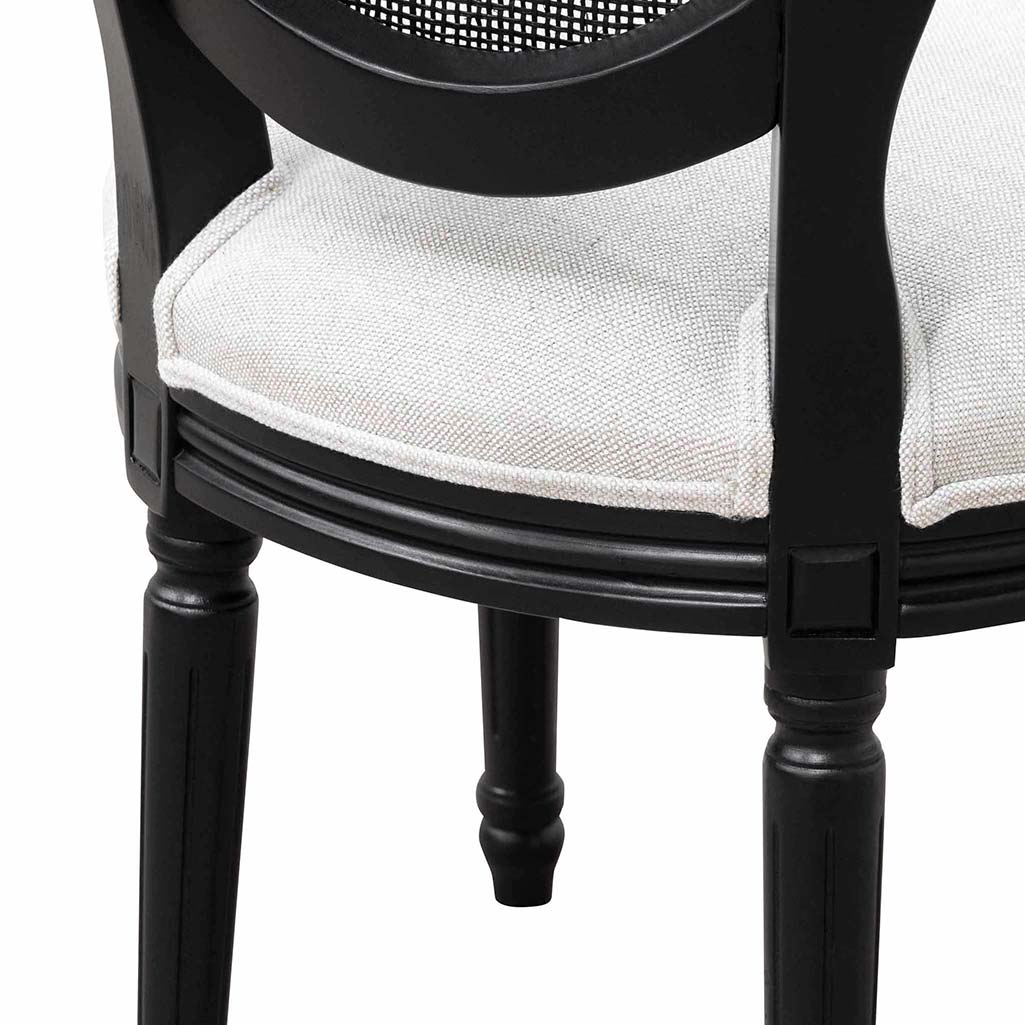




Most people choose a dining chair the way they'd choose a cushion. They look at it, they like it, they buy it. Then it arrives, they slide it under the table, and something feels off. Their knees press into the underside of the tabletop. Or the seat sits so low they're eating with their chin near their plate. Or four chairs that looked fine in the photo turn out to jostle for elbow room the moment real people sit down for a meal.
Almost none of that is about the chair being bad. It's about a few centimetres being wrong. A dining chair is one of the rare pieces of furniture where comfort is decided almost entirely by numbers, and where the numbers have to agree with the table you already own. Get the relationship right and you stop noticing the chair at all, which is exactly what a good dining chair should do. Get it wrong and you'll feel it every dinner.
This guide walks through the measurements that matter, why they matter, and how to check them against your own table before you commit.
The measurement that decides everything: the seat-to-table gap
Before we talk about any single dimension in isolation, understand this: seat height and table height only mean something in relation to each other. What you're really chasing is the gap between the top of the seat and the underside of the tabletop. That gap is where your legs live.
For a comfortable meal, you want roughly 27 to 30 cm between the seat surface and the tabletop. That's enough room to cross your legs, shift around, and slide the chair in without your thighs jamming against the table.
In Australia, most dining tables sit at about 73 to 76 cm high, and most dining chairs have a seat height around 45 to 47 cm. Do the subtraction and you land inside that comfortable window. This is why "standard" chairs work with "standard" tables. The problem starts when one of them isn't standard, which happens more often than you'd think with custom timber tables, reclaimed pieces, or anything imported from a market where the norms differ.
So the first thing to do isn't to look up an ideal seat height. It's to measure your table.
Seat height: measure your table first, then work backwards
Grab a tape measure and check the height from the floor to the top of your tabletop. Then measure to the underside, because a thick tabletop or a deep frame under the table (that horizontal rail is called the apron) eats into your gap.
Say your table is 75 cm high. Aim for a seat height around 45 to 47 cm and you'll have a comfortable clearance. If your table is a chunky farmhouse piece at 78 cm, you can go slightly higher on the seat, closer to 48 cm, or you'll feel like you're reaching up to your plate. If you inherited a lower vintage table at 71 cm, a 45 cm seat suddenly leaves too little room and a shorter seat around 43 cm sits better.
Here's the test for the person actually sitting in it: feet flat on the floor, thighs roughly parallel to the ground, no pressure under the knees. If someone's feet dangle or their knees ride up, the seat is too tall. If they sink and their knees point upward, it's too low. A quick way to sanity-check a chair before buying is to sit on any surface you know the height of, a step stool or a stack of books measured with the tape, and see how it feels at your table.
One thing worth flagging with timber chairs specifically: solid wood seats don't compress the way a padded seat does. A 46 cm upholstered seat can effectively sit a centimetre lower once you're on it. A hardwood seat gives you exactly the number on the label, so what you measure is what you get.
Seat width and depth: comfort for the person, and space for the table
Seat height keeps your legs happy. Width and depth decide whether the person feels crammed or supported, and whether you can fit enough chairs around the table without them fighting for space.
Seat width usually runs from about 40 cm on a slim café-style chair up to 50 cm or more on a generous carver. Forty centimetres is fine for a compact kitchen or a smaller frame. If you're buying for adults who'll linger over long dinners, or you just prefer room to settle in, aim for 45 to 50 cm.
Seat depth (front to back) sits around 40 to 45 cm for most people. Too shallow and you perch on the edge. Too deep and shorter people can't lean back without their feet leaving the floor, so the backrest becomes decorative rather than supportive.
A few practical things to keep in mind when you're weighing up width and depth:
-
Allow about 55 to 60 cm of table edge per person, not just the chair width. People need room for their plate, their glass, and their elbows, and elbows spread wider than shoulders once everyone's eating.
-
If your chairs have arms, measure the total width including the arms, because that's what determines whether two chairs can sit side by side.
-
Deeper seats suit taller people; shallower seats suit kids and shorter adults. If your household is a mix, a middle-of-the-road depth around 42 cm keeps everyone reasonably happy.
Table clearance and legroom: the apron catches people out
This is the dimension almost nobody checks, and it's the one that ruins the most meals. The seat-to-table gap I mentioned earlier assumes a clean underside. Plenty of tables aren't clean underneath.
Look under your table. If there's an apron running along the edge, or a drawer, your real legroom is measured to the bottom of that, not to the tabletop. A table that's 75 cm to the top might only be 66 cm to the underside of a deep apron, and now your comfortable 46 cm chair leaves barely 20 cm of thigh room. That's the pinch people feel without understanding why.
Trestle tables and pedestal tables are the friendlier option here, because there's usually nothing along the edge to bump into. Four-legged tables with a solid frame are where you have to be careful, especially if you want chairs with arms.
The fix is simple: measure floor to underside of the apron, subtract your seat height, and make sure you're left with at least 20 cm, ideally more. If the number's tight, choose a slimmer chair or one without arms.

Armrests, backrests and the details that change the whole look
Armrests are the classic upgrade for the two chairs at the ends of a table, the "carvers." They're comfortable and they signal the head of the table nicely. They also need to tuck under. Measure the height from the floor to the top of the arm and compare it to the underside of your apron. If the arm can't slide under, the chair has to live pulled out from the table, which looks unfinished and gets in the way in a narrow room.
Backrest height is more about proportion than measurement. A tall spindle back or ladder back suits a substantial timber table and a room with height to spare. A low, curved back feels lighter and works better under a window or in a smaller space where a row of tall backs would visually wall off the room. Neither is more correct. It depends on what the chair is sitting next to.
Scale is the quiet detail here. A delicate table with heavy chairs looks bottom-heavy, and vice versa. When you're shopping, hold the chair's overall footprint against the visual weight of your table rather than just checking whether the seat height matches. Two chairs can have identical measurements and one will look right in your room while the other looks borrowed from somewhere else.
How many chairs actually fit around your table
Once the individual chair is right, the last question is how many of them your table can seat without turning dinner into a shuffle. This trips people up because they count place settings from a diagram rather than from real chairs with real gaps.
Work off the 55 to 60 cm per person rule for the long sides, and remember the ends. Here's a rough starting point for rectangular tables:
-
120 cm table: 4 people, two per long side, nothing at the ends
-
150 cm table: 4 to 6, comfortable at four, snug at six
-
180 cm table: 6 comfortably, or 8 if you add a chair at each end
-
210 cm and up: 8, with room to breathe
Round tables work on circumference. A 120 cm round comfortably seats four, and you can push it to six if the chairs are slim and there's no central pedestal foot in the way of anyone's knees. Don't cram a fifth or sixth chair onto a small round just because the tabletop looks big enough. The pinch point is always the legs underneath, not the surface on top.
A quick word on counter and bar height, since it's easy to confuse
If your seating is at a kitchen island or a raised bench rather than a standard table, none of the numbers above apply, and this is where people accidentally buy the wrong thing. A standard dining chair at 46 cm is useless at a 90 cm counter.
For a kitchen counter around 90 cm, you want a stool with a seat height near 65 cm. For a bar bench around 105 to 110 cm, you want a taller stool around 75 cm. The same seat-to-surface logic holds: keep roughly 25 to 30 cm between the seat and the underside of the bench, and you're set. If you're mixing a dining table and an island in an open-plan kitchen, they'll need two different heights, so measure both before you order.
Bringing it together
The whole thing comes down to one habit: measure your table before you fall in love with a chair. Floor to tabletop, floor to underside of the apron, and the width of edge each person gets. With those three numbers in hand, every decision about seat height, width, arms and quantity becomes obvious instead of a guess.
A well-sized dining chair disappears into the meal. You don't think about your knees, you don't perch on the edge, and you don't spend dessert quietly wishing you could push back and cross your legs. That's the goal. A beautiful chair that gets the numbers wrong is just a beautiful chair you'll eventually replace, so it's worth spending ten minutes with a tape measure now to avoid it. If you're choosing solid timber chairs in particular, the height you read on the label is the height you'll sit at, which makes matching them to your table refreshingly predictable.
Frequently asked questions
What is the standard dining chair seat height?
Around 45 to 47 cm from the floor to the top of the seat. That pairs well with the typical Australian dining table height of 73 to 76 cm.
How much space should there be between the seat and the tabletop?
About 27 to 30 cm. Measure to the underside of the table, not the top, because an apron or drawer reduces your actual legroom.
How wide should a dining chair be?
Between 40 and 50 cm. Slimmer chairs suit compact spaces; wider seats and carvers suit longer, more relaxed meals. Allow 55 to 60 cm of table edge per person so no one's fighting for elbow room.
How many chairs fit around a 180 cm table?
Six comfortably along the two long sides, or eight if you add a chair at each end. Always check knee clearance underneath, since that limits seating before the tabletop does.
Do I need chairs with a different height for a kitchen island?
Yes. A standard dining chair is too low for a raised bench. Use a stool around 65 cm for a 90 cm counter, or around 75 cm for a 105 to 110 cm bar bench.