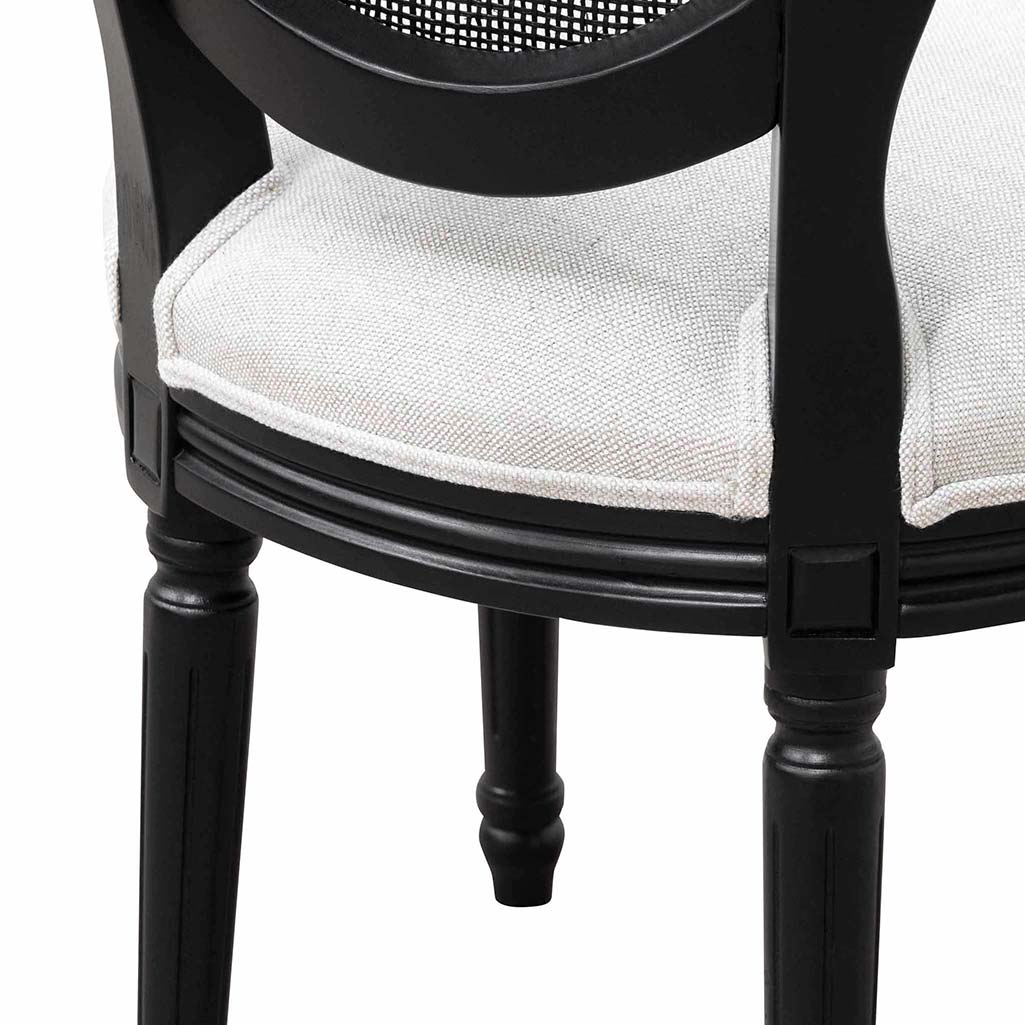




Some people pick a dining chair the way they pick a paint colour. They fall for the leather tone, the leg shape, maybe the stitching, and the arms-or-no-arms question barely gets a second thought. Then the chairs arrive, and the problem shows up on day one: the armrests clunk into the table edge, or the chairs won't slide all the way in, so there's a row of them poking out into the walkway.
It sounds like a small detail. It isn't. Whether your leather dining chairs have arms changes how the room feels, how many people you can actually seat, how comfortable a long lunch is, and even how much you'll spend. So before you get attached to a particular chair, it's worth understanding what the arms are really doing for you, and what they're taking away.
What arms actually change about a dining chair
An armrest does more than give your elbows somewhere to go. It adds width to the chair, height to its profile, and material to its price. On a leather chair specifically, the arms also become one of the first surfaces to show wear, because that's where hands rest, grip, and push.
Armless chairs strip all of that back. They're narrower, lighter to move, and they disappear under the table when you're not using them. What you lose is the support and the sense of occasion that a proper armed chair gives.
Neither is better in the abstract. The right answer depends on your table, your room, and honestly, how you eat.
The space question comes first
Before comfort, before looks, check the fit. This is where regret usually happens.
Will the arms clear your table?
Australian dining tables tend to sit around 73 to 76 cm high. The armrest on a dining chair usually lands somewhere between 60 and 68 cm off the floor. If the table has a thick top or a deep apron (that rail running under the tabletop), the arms can catch on the underside instead of sliding beneath it.
Measure the gap from the floor to the lowest point under your tabletop, then compare it to the arm height of the chair you're eyeing. If the arms don't clear that rail, the chairs will always stick out a little, and you'll feel it every time you sit down.
Can you still tuck the chairs away?
Armless chairs push right in, which matters more than people expect. In a smaller apartment or an open-plan space where the dining area doubles as a walkway, being able to fully tuck the chairs keeps the room usable. A set of wide armed chairs, even lovely ones, can eat 15 to 20 cm of clearance each and make a compact room feel crowded.
How many can you fit along the table?
Arms add roughly 10 to 15 cm of width per chair. On a 1.8 metre table you might comfortably seat six armless chairs but only four with arms. If you regularly host, that difference is the gap between everyone fitting and someone eating off a side table.
Comfort depends on how you use the room
Here's the part that gets skipped. Think about how your household actually eats, not how you imagine it in a catalogue.
If dinner in your house is a quick affair and everyone's up in twenty minutes, armless chairs are plenty. But if you're the sort of family that stays at the table talking long after the plates are cleared, or you host dinners that run for hours, arms earn their place. Leather forearm rests are genuinely comfortable to lean on, and they change how long you can sit before you start shifting around.
There's also the work-from-home factor. Plenty of Australians have turned the dining table into a part-time desk. If you spend afternoons there on a laptop, an armed chair supports your posture in a way an armless one never will.
And don't overlook getting in and out. For older family members, or anyone with a dodgy knee, armrests give something solid to push up from. Armless chairs are easier to slide into from the side, but harder to rise from gracefully. If accessibility matters in your home, that alone can settle it.
What leather brings to the decision
Leather changes the calculation in a few ways you won't get with fabric or timber.
For one, leather arms feel good. They warm to the touch, soften over time, and develop a patina on the armrests where your hands sit most, which many people love. The flip side is that those same spots wear fastest. Hand oils, sunscreen in summer, the constant push-and-grip of getting up all concentrate on the arms. On a pigmented or protected leather, that wear is minimal and easy to wipe down. On a natural aniline leather, it's part of the character, but it will show.
Armless leather chairs sidestep most of that. The seat and back still get use, but you remove the surface that takes the hardest daily contact. If you've chosen a paler leather, or a softer unprotected finish, going armless can keep the set looking newer for longer.
Cleaning is simpler too. Fewer curves and corners means fewer spots for crumbs and dust to settle, and a quick wipe covers the whole chair.

Matching the chairs to your room
Style isn't just taste here. Arms carry visual weight, and that weight either suits your space or fights it.
-
Small or open-plan spaces: Armless leather chairs read as lighter and let the eye move through the room. In an apartment or a compact dining nook, they stop the area feeling boxed in.
-
Larger, more formal rooms: Armed chairs fill the space and give a dining setting presence. Around a big timber table, a row of armless chairs can look a touch mean by comparison.
-
Modern, minimal interiors: Clean armless silhouettes tend to sit better with contemporary tables and slim legs.
-
Traditional or statement settings: Armed chairs, sometimes called carvers, bring the sense of formality that a classic dining room wants.
If you're unsure, stand back and picture the chairs pushed in around the table. That's how you'll see them 90% of the time, and it tells you more than looking at a single chair on its own.
The middle path most people forget
You don't have to choose one or the other. A very common setup, and one I'd point most people toward if their table allows it, is to put two armed chairs at the ends and armless chairs down the sides.
The armed chairs at the head mark the natural "host" positions and add a bit of ceremony. The armless chairs along the sides keep the setting light, tuck in fully, and let you seat more people. You get the comfort of arms where you're most likely to linger, without the bulk and cost of arms on every seat. Just make sure the two styles share the same leather and leg design so the set still reads as one collection.
A quick way to decide
If you're still on the fence, run through this:
-
Measure the clearance under your table. If the arms won't fit beneath the apron, the decision is made for you.
-
Count how many seats you truly need. If space is tight, armless wins on numbers.
-
Think about your slowest meals. Long, social dinners lean toward arms.
-
Consider who's sitting. Older family members or anyone who needs help rising benefit from arms.
-
Look at your leather. Pale or unprotected finishes stay cleaner longer without armrests taking the hardest wear.
The bottom line
Arms versus armless isn't a style footnote. It quietly decides how many people you seat, how a small room breathes, how comfortable your longest dinners are, and where your leather will wear first. Armed leather chairs reward homes that linger at the table and have the space to carry them. Armless chairs suit tighter rooms, bigger guest lists, and anyone who wants a lighter, easier-to-maintain look. And if you can't pick a side, the carvers-at-the-ends approach usually gives you the best of both.
Measure first, then choose the chair that fits how you actually live, not just the one that looks best in the photo. Leather lasts for years, so it's worth getting this part right the first time.
FAQs
Are dining chairs with arms less comfortable for wider body types?
They can be. Armed chairs fix the seat width between the rests, so anyone broader may find them tight. Armless chairs have no side limit, which makes them more forgiving. If comfort across different body sizes matters, check the internal width between the arms before buying.
Do armed leather chairs cost more than armless ones?
Usually, yes. Arms mean more leather, more framework, and more construction, so an armed chair typically costs more than the armless version of the same design. Mixing two carvers with armless side chairs is one way to get the look without paying for arms on every seat.
How do I know if armed chairs will fit under my table?
Measure from the floor to the lowest point under the tabletop, including any apron rail, then compare that to the chair's arm height. If the arms sit higher than that gap, they won't slide underneath and the chairs will stick out.
Which shows wear faster on leather, the arms or the seat?
The arms. Hands rest, grip, and push there constantly, so armrests pick up oils and wear before the seat does. On protected leather this is easy to wipe away; on natural aniline leather it becomes part of the patina. Armless chairs avoid this surface entirely.
Can I mix armed and armless chairs around one table?
Yes, and it's a popular choice. Two armed chairs at the ends with armless chairs along the sides is a practical, balanced setup. Keep the leather colour and leg style consistent so the set still looks intentional rather than mismatched.